Your truck door is your billboard. Every mile, your logo gets seen by thousands of drivers, dispatchers, shippers, and brokers — and on load boards, perceived legitimacy is what gets you the call. A polished mark on the door, the trailer, and your MC profile measurably affects how often you get loaded versus passed over.
This is a working library of 20 trucking logo directions covering owner-operators through multi-truck fleets and the haul types most likely to need branding in 2026. Each was generated by SVG Genie's trucking logo maker using prompts you can adapt for your own operation.
What separates a serious trucking logo from a hobby one
Three things, in order of impact:
- It reads at 65 mph from across a highway. Bold shapes, strong negative space, and a single hierarchy of focus. If your logo needs five seconds of staring to parse, it does not work on a moving truck.
- It survives at vinyl-decal sizes. Cutters can't handle hairline details. Avoid micro-elements that fall apart when scaled to a 36-inch door decal.
- It earns trust on a load-board profile. Brokers do business with people who look like a real company. The right mark beats a Comic-Sans wordmark on the same MC number.
Heritage and family-owned (4 directions)
1. Vintage flatbed crest
A circular crest containing a flatbed truck silhouette flanked by mountains, weathered ivory and oxblood. The vintage emblem style reads "we've been hauling for two decades" — works for owner-operators leaning on heritage.
2. Owner-operator hand-drawn
A horse-and-engine hybrid icon with custom hand-lettering. Deep navy and warm rust. The artisan vector style fits one-truck operations where the operator's identity is the brand.
3. Family multi-generation
A vintage semi-truck silhouette in three-quarter view inside a circular emblem, cream and forest. Classic serif wordmark inside the emblem signals heritage — appropriate for "& Sons" family operations.
4. Patriotic owner-op
A stylized American flag waving over a road horizon, navy red and ivory. The patriotic angle resonates with a real segment of the owner-operator market — but use it because it reflects you, not as a costume.
Modern and corporate fleet (4 directions)
5. Modern logistics arrow
An arrow-shaped truck profile cutting forward, slate gray and electric blue. The modern minimal style reads "established multi-truck fleet" — built for shippers who want to see a corporate operation.
6. Container intermodal

A shipping container forming a geometric A, navy and steel gray. For intermodal and drayage operations serving port-to-warehouse routes.
7. LTL freight stacked

A stylized pallet stacking icon, slate and electric blue. LTL (less-than-truckload) operations live or die on perceived organization — the geometric icon signals "we'll know which pallet is yours."
8. Cross-border NAFTA

Two arrows crossing forming an X over a road horizon, gray and electric red. Right for carriers running USA-Mexico or USA-Canada routes — the X visual communicates the cross-border specialty.
Specialty hauls (5 directions)
9. Reefer cold chain
A snowflake forming the shape of a trailer rear, steel blue and white. Cold-chain shippers (pharma, produce, frozen) are picky about who they trust. The reefer-specific signal earns those loads.
10. Auto transport
Stacked car silhouettes inside an open-deck trailer outline, vibrant red and chrome. Auto transport is its own category — shippers searching specifically for car haulers respond to category-specific marks.
11. Industrial tanker

A bold geometric tank icon, charcoal and safety yellow. Industrial sans-serif wordmark. The visual weight reads "we move chemicals and dry-bulk loads at scale."
12. Hazmat tanker

A stylized shield containing a hazmat diamond, charcoal and safety orange. Built for carriers running endorsed hazmat freight where credentialing is the brand.
13. Logging timber
Crossed logs inside a circular crest, forest green and warm umber. The vintage style fits timber and logging operations where the work is heritage-flavored.
Construction and heavy (3 directions)
14. Heavy industrial
A dump-truck silhouette in three-quarter view, deep gray and construction yellow. Slab serif wordmark anchors it as a serious operator. Right for dump trucking and construction hauling.
15. Hot shot specialty

A lightning bolt cutting through a truck silhouette, vibrant yellow and matte black. Hot-shot work is speed-led — the kinetic visual matches the service.
16. Cattle livestock
A stylized longhorn skull inside a hexagonal crest, weathered ivory and rust. Cattle and livestock haulers serve ranchers and feedlots — Western heritage visuals belong here.
Local and recreational (4 directions)
17. Local box-truck delivery
A stylized box truck waving from a city skyline, warm orange and navy. Rounded sans-serif keeps it approachable. Built for last-mile and local-delivery operations marketing to small businesses.
18. RV transport
A motorhome silhouette intersected by a road arrow, sand and slate. RV transport is a defined niche — RV manufacturers and dealers search for carriers using "RV transport" specifically.
19. Boat hauler

A delicate boat-hull silhouette over a wave line, navy and warm gold. Yacht and boat transport sit between marine and trucking visual languages — this leans elegant rather than industrial.
20. Long-haul cross-country
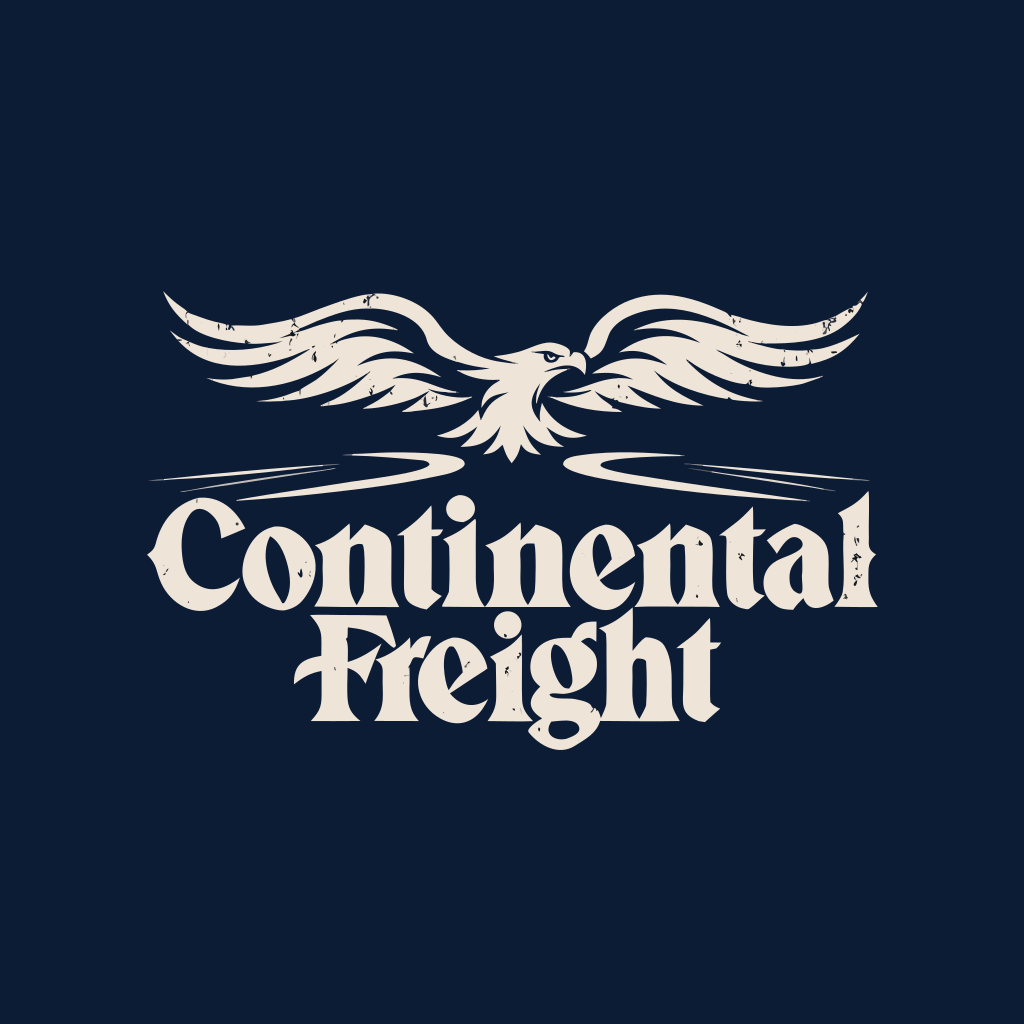
A stylized eagle in flight over a road horizon line. Weathered ivory and oxblood. The classic long-haul motif handled with restraint — fits OTR drivers who run coast-to-coast.
Matching the form answers to these directions
Each logo above came from the same trucking logo maker. The form asks five questions — business name, what you haul, brand feel, visual style, color direction. Match those answers to the example you like:
- Sample #1 (vintage flatbed crest): haul "flatbed", feel "rugged classic Americana", style "vintage classic", color "monochrome black" or "warm earthy"
- Sample #5 (modern logistics): haul "general freight", feel "modern corporate", style "modern minimal", color "cool modern"
- Sample #9 (reefer cold chain): haul "refrigerated", feel "modern corporate" or "premium fleet", style "elegant refined", color "cool modern"
Trucking logo design rules
Do:
- Pick a logo that reads from across a highway lane.
- Test in solid black before approving — most decal cuts are one color.
- Choose colors that work on a white truck and a dark truck. You may switch trucks.
- Get the SVG. Wrap shops will ask for it.
Don't:
- Use a logo with thin hairline detail. It won't cut on a vinyl plotter.
- Lean on generic chrome-and-flames clip-art. Looks 2003.
- Use script fonts for the wordmark — script doesn't read at distance.
- Pay per file size. SVG handles every size from your MC profile photo to a trailer wrap.
Frequently asked questions
Will this logo work for a vinyl decal on a truck door?
Yes — that's exactly what SVG is for. Vinyl printers cut decals directly from vector paths. Send the SVG to your wrap shop and they can scale it to any door, trailer, or vehicle size.
Will the printer ask for EPS or AI instead?
Some still do. Both convert from SVG cleanly — SVG Genie includes a free SVG-to-EPS converter at /tools/svg-to-eps. The same source file works for both.
Can I add my MC and DOT numbers?
Yes — typically as separate text below the logo on the truck door. That's the industry-standard layout. Or open the SVG in any design tool and add them directly to the artwork.
How much does this cost compared to a designer?
Trucking-specific designers typically quote $400–1,500 with a 1–3 week turnaround. AI generation produces the same quality of output in under two minutes — first one free, additional generations a few dollars.
Will it look serious enough for shippers and brokers?
Pick "modern corporate" or "premium fleet" for brand feel and the AI will produce a mark with the visual weight load boards expect. Avoid "rugged classic" if your customer base is corporate shippers rather than ranchers.
Ready to make yours
Pick the closest direction above and open the trucking logo maker. First logo is free, no credit card required.
We'll build your trucking logo
Ready for door decals, trailer wraps, and DOT paperwork. First one is on us — no card needed.
About This Article
This article was written by SVG Genie Team based on hands-on testing with SVG Genie’s tools and years of experience in vector design and web graphics. All recommendations reflect real-world usage and are reviewed by the SVG Genie editorial team for accuracy.
About the Author
SVG Genie Team
SVG Design Expert & Technical Writer at SVG Genie
SVG Genie Team is a vector design specialist and technical writer at SVG Genie with years of hands-on experience in SVG tooling, AI-assisted design workflows, and web graphics optimization. Their work focuses on making professional vector design accessible to everyone.
More articles by SVG Genie Teamarrow_forward